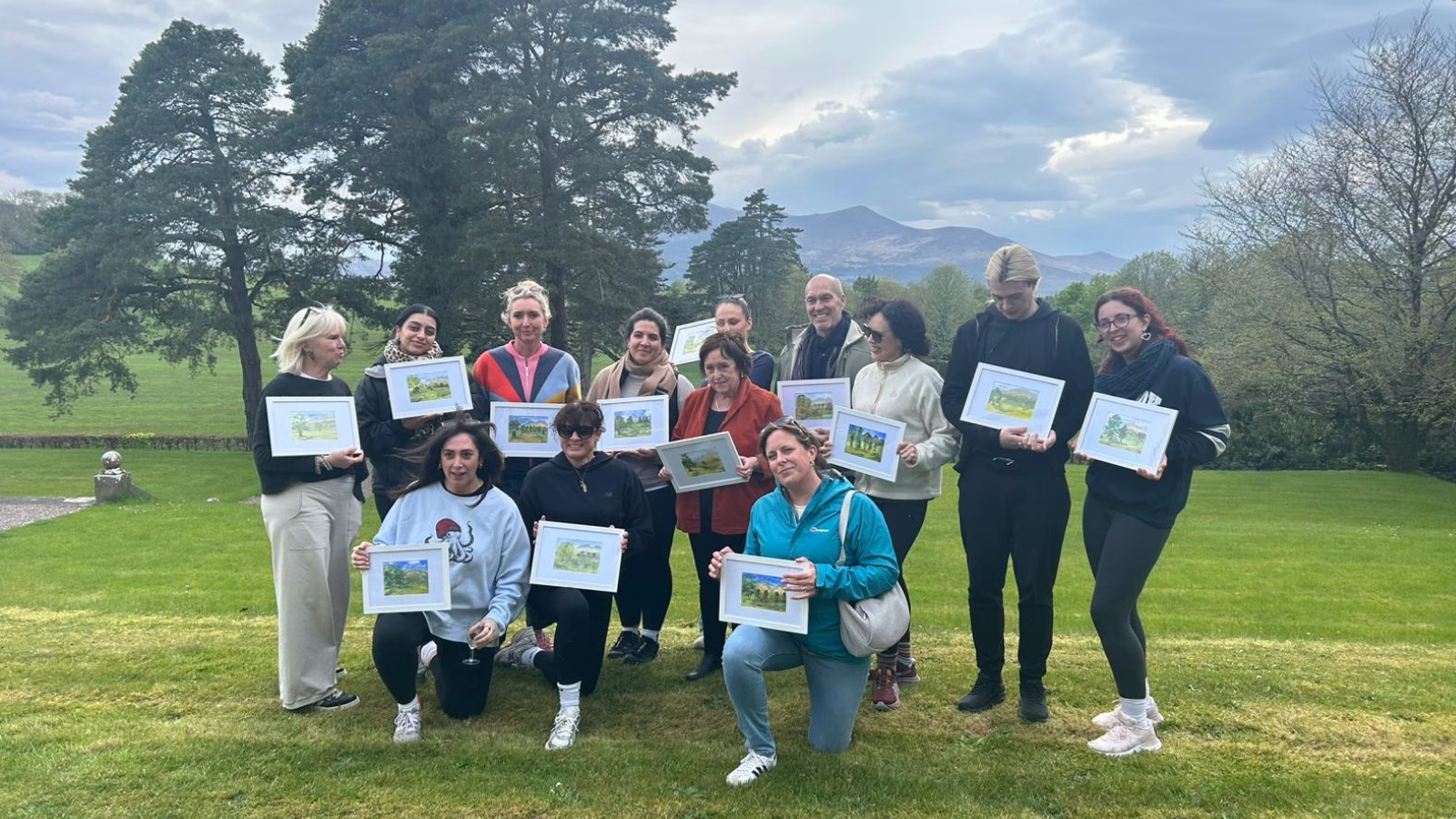
In April 2026, fourteen of the UK’s leading event planners took an extra day to explore the benefits of travelling slow on a familiarisation trip to Ireland through “Ireland Overland.
Created by Anna Peters of Evolve Events, in collaboration with Dublin Convention Bureau, Kerry Convention Bureau, Meet in Ireland and Partners, Meet in Wales, Railtours Ireland and Irish Ferries, the programme brought the cohort of event professionals from London to Ireland by rail and ferry, before travelling onward by train to Kerry. Rather than treating the journey as a logistical compromise, Ireland Overland reframed it as part of the event itself. Among the travellers was Aarron McGurk, a Culture and Operations Lead at Chorus Events, one of onboard:earth’s corporate event partners.
In this guest article, Aarron shares how the experience consolidated his understanding of how Chorus’s clients can incorporate slow travel into their events to offer far more than just cutting carbon emissions, and use the journey to enrich the overall event experience by programming connection time, enabling cultural and storytelling moments, supporting local communities and promoting a holistic approach to wellbeing that will stay in delegates’ minds long after the event ends.
“Ireland Overland was an industry-first FAM trip that set out to prove something the events industry has been circling for years: that sustainable event design isn’t a compromise. Done well, it’s a better experience for delegates and for destinations.
Ireland Overland was more than a familiarisation trip. It was a working example of how slow travel can be designed into experiences from the very first moment of departure.
The result was not only memorable. It was measurable.
The trip was awarded Platinum by From Now, representing the highest level of sustainability performance across its five pillars: accessibility, environmental impact, community, diversity, equity and inclusion, and wellbeing. It placed Ireland Overland in the top 1% of all reports measured by From Now, demonstrating exceptional commitment, innovation and impact across environmental and social outcomes. The programme scored 100% across accessibility, environmental, community and DEI, with 82% for wellbeing.
From the outset, the experience challenged one of the industry’s most common assumptions: that speed is always the most efficient choice. The group departed London by train, travelling through Wales to Holyhead before crossing the Irish Sea by ferry. At Holyhead, Meet in Wales arranged a Welsh Male Choir to welcome the group, transforming what could have been a functional transfer into a cultural moment.
On board the ferry, the crossing became usable programme time. A workshop led by From Now and Be in Your Element explored human sustainability, while attendees had space to decompress, connect and reflect.
This time for space and connection became one of the central lessons of the trip: when designed properly, slow travel does not reduce the experience. It enriches it.
Using data from Fáilte Ireland’s Business Events Carbon Calculator Tool, From Now calculated that the train and ferry element saved 415.4 kg CO₂e as a group by not flying.
The report frames this saving as equivalent to one month of electricity use in a small UK household or driving from London to Rome and back. Total travel emissions were calculated at 1,742.4 kg CO₂e, rising to 2,015.3 kg CO₂e when coach travel within Ireland was included.
Importantly, the programme was not presented as purist or unrealistic. The group returned by plane on the Saturday, recognising that many attendees needed to get home to families and weekend commitments. For Aarron, this was a strength rather than a flaw: “The trip understood sustainability as something holistic. It considered carbon, but it also considered people. That made it feel usable for real client briefs, not just an idealised version of what sustainable travel should be.”
Across Dublin and Kerry, the itinerary showed how sustainability can sit inside experience design rather than around it. In Dublin, In Our Shoes Walking Tours brought social mobility and local storytelling to the forefront, highlighting the importance of understanding the communities where events take place and investing in them. Teeling Whiskey Distillery and the Convention Centre Dublin demonstrated how venues can connect heritage, innovation and resourcefulness, while JANDO’s screen-printing workshop showed the value of hands-on local creativity.
In Kerry, the experience widened into landscape, hospitality, food systems and permanence. The group visited Ballygarry Estate, The Europe Hotel and Resort, Muckross Traditional Farms, Innisfallen Island, The Brehon, Coolclogher House, Killarney Urban Farm, Pig’s Lane and J.M. Reidy’s. Together, these experiences created a narrative of place that moved between heritage, wellbeing, nature, hospitality and innovation. What really stood out is the passion for storytelling and how that passion pushes the green agenda. The idea of permanence – creating stories and structures that last was the simple and humbling ‘aha’ moment the group needed.
Food was a major part of the sustainability story. From Now’s report recorded 2,074 kg CO₂e from catering, while noting that all food was sourced locally to reduce transport emissions and support regional producers. Red meat was removed from the standard menu, and where it appeared, it was sourced from local suppliers to prioritise regional provenance and reduce supply-chain impact.
Community impact was also embedded throughout. Local suppliers and regional businesses were prioritised, and direct contributions were made to all social and environmental causes.
For Chorus, the trip offered practical inspiration for future briefs, demonstrating a model that could be adapted across client work: journeys that begin when someone leaves their front door, programmes that activate smaller towns along the way; and event design that spreads economic value rather than concentrating it in one destination.
In an age where AI is accelerating the work around experiences, Ireland Overland offered a timely counterpoint. If technology can make planning faster, perhaps human experience can be allowed to slow down. Travel time can become connection time. Transfers can become storytelling. Regional stops can become meaningful moments of investment.
Ireland Overland proved that slow travel is not simply about taking longer. It is about designing better.”
___
Chorus Agency is a boutique creative agency bringing brand stories to life through ideas-led strategy, design and experiences.
Aarron McGurk is Culture & Operations Lead at Chorus Agency: A recognised Power 50 Green Champion, Aarron has led the development of Chorus’s ISO 20121–aligned Sustainable Event Management System and is known for translating sustainability strategy into practical tools that work in real-world delivery.
Find Aarron on Linkedin
Discover Chorus Agency